

Hi, I’m Jannelle, a Cognitive Behavioural Therapist specialising in supporting children, adolescents and young adults aged 10–25, as well as the parents and carers who care about them.
The truth is, many of the families I work with arrive feeling confused, worried and often exhausted from trying to figure things out alone. Young people might be struggling with anxiety, low mood, OCD, trauma, emotional overwhelm, or difficulties at school or socially. Parents often know something isn’t right but aren’t sure how to help anymore.
My role is to help everyone understand what’s going on and then work together on practical ways forward.
My approach
I work using Cognitive Behavioural Therapy (CBT), an evidence-based therapy widely used to support young people experiencing anxiety, depression, OCD, trauma and other emotional difficulties. But therapy isn’t just about techniques. Young people need to feel respected, listened to and taken seriously before they are willing to engage. I take time to build trust, meet them where they are, and involve them in shaping the work we do together. Their voice and perspective matter. At the same time, parents are often a crucial part of the process. I work closely with parents and carers to help them understand their child’s experiences and provide clear, practical strategies that can be used outside of sessions. When young people feel understood and parents feel more confident in how they respond, change becomes much more possible.
Understanding the world young people live in
One of the things that shapes my work most strongly is my experience across both the education system and the healthcare system.
Before becoming a therapist, I worked within schools supporting children with special educational needs and social, emotional and mental health difficulties. Later, I worked within NHS mental health services for children and young people, and in a counselling charity supporting young people aged 10–25.
This means I understand the environments young people are navigating every day e.g. the pressures of school, expectations from teachers, social challenges, academic stress and the complexity of accessing mental health support.
It also means I’m able to help families navigate these systems more confidently. Sometimes this involves helping parents understand what support should be available. Other times it means helping young people communicate their needs to schools, GPs or other professionals.
Many families tell me that having someone who understands both systems, and can advocate for them when needed, makes an enormous difference.
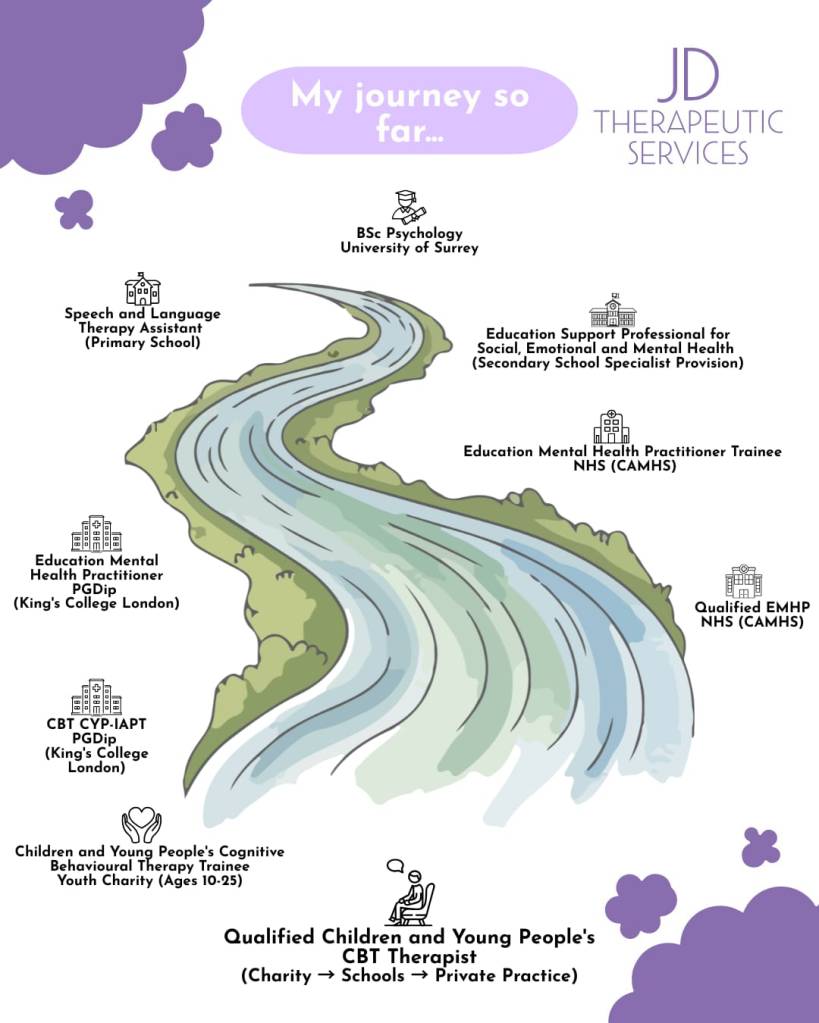
Main qualifications
BSc Psychology (Hons) – University of Surrey
Postgraduate Diploma in Education Mental Health Practice (Low intensity Cognitive Behavioural Therapy) – King’s College London
Postgraduate Diploma in Children and Young People’s IAPT Therapy (High Intensity Cognitive Behavioural Therapy) – King’s College London
Additional certifications/Continued professional Development
Level 3 Certificate in Counselling Studies (CPCAB)
CBT Strategies for Working with Emotional Regulation and Self-harm (Anna Freud Centre)
Trauma focused CBT for children and young people with complex PTSD – The importance of a model-based formulation (BABCP)
Autism Affirming Therapist Accreditation (The Autism Wellbeing Project)
Autism and Co-occurring Conditions: Adapting Psychological Therapies (ACAMH)
What working with me is like
Families often describe my approach as warm, clear, frank and practical.
I won’t judge you or your child. I also won’t leave you guessing about what to do next.
Instead, we work together to understand the difficulties properly, set meaningful goals, and take manageable steps towards them. Young people remain at the centre of this process, while parents are supported to feel more confident alongside them.
Because when young people feel understood and supported, both at home and in the environments around them, they are far more capable of change than they often realise.
“How can we ever say thank you enough! We are so blessed that you were there for (our son). Thank you for everything.”
— Parent of boy aged 13

